
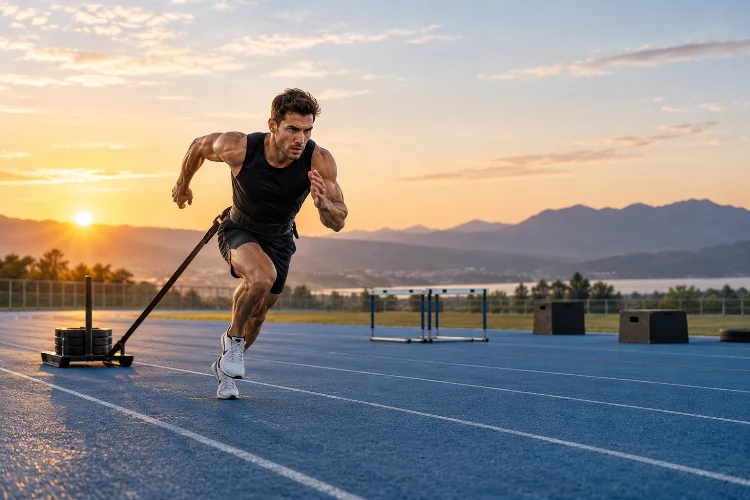
Ever wondered why some athletes seem capable of sprinting faster, jumping higher, and maintaining impressive endurance while others struggle to improve despite spending countless hours training?
The difference often comes down to how intelligently they approach physical conditioning.
Building exceptional athletic fitness isn’t simply about lifting heavier weights or running longer distances. It’s about developing multiple physical abilities that work together to improve performance when it matters most.
That’s where advanced athletic conditioning methods for peak physical fitness come into play.
Modern sports performance training combines cardiovascular endurance, explosive power, muscular strength, speed development, agility, and strategic recovery.
Instead of treating these qualities as completely seperate goals, effective conditioning programs develop them through carefully structured training sessions.
And here’s the exciting part.
You don’t need to be a professional athlete to benefit from these principles.
Whether you’re preparing for competitive sports, improving your recreational fitness, or simply looking to become stronger and more athletic, understanding advanced conditioning strategies can help you train more effectively.
In this guide, we’ll explore evidence-based training methods, practical workout examples, and programming strategies that can help you push your physical capabilities further without sacrificing long-term progress.
1. Understanding the Foundations of Advanced Athletic Conditioning
Before jumping into intense workouts, it’s worth understanding what athletic conditioning actually involves.
Many people associate conditioning with cardio exercises that leave them breathing heavily and covered in sweat.
However, genuine athletic performance requires much more than cardiovascular endurance.
The Three Energy Systems Behind Athletic Performance
Your body relies on three interconnected energy systems to support physical activity.
The phosphagen system provides energy rapidly for extremely short, explosive efforts such as sprint starts, maximum jumps, and heavy lifts.
The glycolytic system contributes substantially during demanding activities lasting several seconds to a few minutes, including repeated high-intensity efforts.
Meanwhile, the oxidative system supports prolonged exercise and helps restore energy between intense movements.
These systems don’t operate independently. They contribute simultaneously, although their relative importance changes according to exercise intensity and duration.
Consider a soccer player.
During a match, they might sprint for several seconds, jog across the field, accelerate again, and repeatedly change direction.
Their conditioning must support explosive movements, repeated efforts, and sustained activity throughout the game.
That’s why advanced sports conditioning involves developing several overlapping physical qualities rather than focusing exclusively on one type of exercise.
Training According to Athletic Demands
A sprinter, basketball player, and long-distance cyclist don’t need identical conditioning programs.
Sprinters generally prioritize acceleration, maximal velocity, explosive strength, and sufficient recovery between high-quality efforts.
Basketball players need repeated sprint ability, rapid deceleration, lateral movement, jumping power, and cardiovascular fitness.
Endurance cyclists focus more heavily on aerobic capacity, sustainable power output, movement efficiency, and resistance to fatigue.
The key principle is specificity.
Your training should reflect the physical demands of your sport or performance goals while maintaining enough general fitness to support overall development.
2. High-Intensity Interval Training for Superior Cardiovascular Fitness
High-intensity interval training, commonly known as HIIT, remains one of the most useful approaches for developing cardiovascular performance.
Rather than exercising at one steady pace, HIIT alternates demanding work intervals with carefully selected recovery periods.
This structure allows athletes to accumulate meaningful time at high exercise intensities without maintaining those intensities continuously.
How HIIT Improves Athletic Performance
HIIT challenges the cardiovascular system and can encourage adaptations associated with improved oxygen delivery and utilization.
One important measurement is VO2 max, which represents the maximum rate at which your body can consume oxygen during intense exercise.
A higher VO2 max generally indicates greater aerobic capacity, although sport-specific performance also depends on movement economy, technique, and other factors.
A 2025 systematic review and network meta-analysis by Yang and colleagues analyzed 51 studies involving 1,261 athletes.
The researchers found that HIIT, sprint interval training, and repeated-sprint training improved VO2 max compared with conventional training controls.
However, the differences among these three interval methods weren’t statistically significant.
That means there isn’t one universally superior interval format for every athlete.
Practical HIIT Workout Methods
One commonly used aerobic interval structure involves four challenging efforts lasting approximately four minutes each.
Between intervals, athletes perform around three minutes of easy movement to recover partially before the next effort.
For example, you could cycle hard for four minutes, pedal easily for three minutes, and repeat the sequence four times.
The work intervals should feel demanding but controlled rather than like an all-out sprint.
Another option involves shorter intervals, such as 30 seconds of hard running followed by 30 seconds of easy jogging.
Repeating this pattern for eight to twelve minutes can create a challenging conditioning session.
However, the exact workout should depend on your experience, current fitness, and overall training load.
For athletes unfamiliar with intense intervals, starting with fewer repetitions and longer recovery periods is generally more sensible.
Avoid Turning Every Workout Into HIIT
Here’s an important point that often gets overlooked.
More high-intensity exercise doesn’t automatically produce better conditioning.
Frequent demanding intervals can accumulate substantial fatigue, particularly when combined with strength training, sprinting, and competitive sports.
For many recreational athletes, one or two dedicated HIIT sessions each week provide a reasonable starting point.
The goal is improving aerobic power while maintaining enough recovery capacity to perform other important training sessions effectively.
3. Repeated-Sprint Training and Change-of-Direction Development
Being fast once is impressive.
Being able to accelerate repeatedly while maintaining speed under fatigue is another challenge entirely.
That’s where repeated-sprint training becomes valuable.
Developing Repeated-Sprint Ability
Repeated-sprint training involves performing short, near-maximal or maximal sprints separated by relatively brief recovery periods.
These sessions challenge both muscular performance and the body’s ability to restore energy between demanding efforts.
A 2024 meta-analysis by Thurlow and colleagues examined 40 publications on repeated-sprint training.
The findings supported improvements in sprint performance, VO2 max, intermittent running capacity, repeated-sprint ability, jumping performance, and change-of-direction ability.
These adaptations make the method particularly relevant for athletes involved in soccer, rugby, basketball, and other intermittent sports.
A practical introductory session might involve six 20-meter sprints separated by approximately 30 seconds of recovery.
After completing the set, an athlete could rest for several minutes before performing another set if their conditioning and technique allow it.
This is an illustrative progression, not a universal prescription.
Athletes aiming to improve maximal sprint speed should generally use longer recovery periods to preserve sprint quality, while shorter rests place greater emphasis on repeated-effort conditioning.
Improve Agility Through Controlled Deceleration
Many athletes spend considerable time practicing acceleration but neglect the ability to slow down effectively.
Yet efficient deceleration is essential for changing direction quickly.
Imagine sprinting toward a cone, planting your outside foot, and accelerating toward another target.
Successful movement requires coordinated braking, body control, strength, and rapid force production.
Useful drills include five-meter acceleration-and-stop exercises, lateral shuffles, planned cutting movements, and progressively faster shuttle runs.
Start with predictable movements before progressing toward reactive drills involving visual or verbal cues.
Remember that changing direction and true agility aren’t exactly the same thing.
Change-of-direction drills involve planned movements, while agility also includes perceiving and reacting to unpredictable situations.
Both deserve attention in a complete athletic conditioning program.
4. Plyometric Training and Explosive Strength Development
If you want to jump higher, accelerate faster, or produce force more explosively, plyometric training deserves a place in your program.
Plyometrics involve rapid muscle-tendon loading followed by forceful movement.
Common examples include vertical jumps, bounding, lateral hops, and certain types of medicine-ball throws.
Why Plyometrics Improve Athletic Power
Many plyometric exercises use the stretch-shortening cycle.
During this process, muscles and tendons rapidly absorb and release energy while the nervous system coordinates muscular activation.
Consider a countermovement jump.
You quickly lower your body before immediately driving upward.
That rapid transition helps produce greater explosive output than a movement performed without an initial countermovement.
A 2025 meta-analysis by Sun and colleagues examined 70 studies involving 1,703 conditioned adults.
The analysis reported improvements across several performance measures, including sprint speed, jump height, reactive strength, and agility-related tests.
These findings support plyometric training as a useful method for developing explosive athletic qualities.
Combining Strength Exercises With Plyometrics
One advanced strategy involves pairing heavy resistance exercises with explosive movements.
This approach is often called contrast training or complex training, depending on how exercises are organized.
For example, an athlete might perform three heavy squat repetitions, recover adequately, and then complete three controlled vertical jumps.
The theory is that appropriately timed heavy exercise can temporarily enhance subsequent explosive performance in some individuals.
However, the response varies, and fatigue can easily cancel out the potential benefit.
A systematic review and meta-analysis by Liu and colleagues in 2024 suggested that combining strength, plyometric, and sprint-based methods can improve repeated-sprint performance in team-sport athletes.
Still, the certainty of evidence was low to very low, so these findings shouldn’t be treated as proof that complicated combinations always outperform simpler programs.
Focus on Quality Rather Than Jump Quantity
Plyometric training isn’t about completing hundreds of jumps until your legs collapse.
Landing mechanics, movement speed, and technical consistency matter more than accumulating unnecessary repetitions.
A modest session could include three sets of four countermovement jumps followed by three sets of five lateral bounds per side.
Allow enough rest to maintain explosive performance.
Athletes should first demonstrate appropriate strength, balance, and landing control before attempting demanding depth jumps or high-impact plyometric combinations.
When movements become sloppy, it’s usually time to reduce the workload rather than push through fatigue.
5. Building Aerobic Endurance With Smarter Intensity Distribution
High-intensity workouts attract plenty of attention, but lower-intensity endurance training remains essential for many athletes.
In fact, constantly training at a moderately hard pace can create substantial fatigue without always providing the best balance of training stimulus and recovery.
This is why endurance coaches often pay close attention to training intensity distribution.
Understanding Polarized Training
Polarized training generally distributes a large proportion of endurance work at low intensity, with a smaller proportion performed at high intensity.
Relatively little training takes place in the demanding middle-intensity zone.
For example, an endurance athlete might complete several easy aerobic sessions and one or two challenging interval workouts during the week.
The easier sessions develop aerobic fitness without creating the same level of immediate fatigue as repeated high-intensity training.
The harder workouts provide a complementary stimulus for cardiovascular performance.
A 2024 systematic review and meta-analysis by Oliveira and colleagues included 17 studies involving 437 participants.
It found a small advantage for polarized training in improving VO2 peak compared with other intensity distributions.
However, that doesn’t mean polarized training is always superior for every athlete or performance outcome.
The most effective intensity distribution depends on sporting demands, training history, and available recovery resources.
Why Easy Aerobic Training Still Matters
Easy running, cycling, swimming, and rowing can support cardiovascular development while remaining comparatively manageable.
For many athletes, an easy pace is one at which conversation remains possible without significant breathlessness.
A practical session might involve 30–50 minutes of steady cycling or jogging.
The duration can be adjusted according to sport, experience, and recovery needs.
Aerobic conditioning is especially useful for athletes who must repeatedly produce high-intensity efforts throughout extended competitions.
However, endurance training shouldn’t replace the explosive and technical work required for speed- and power-oriented sports.
The idea is to develop a strong aerobic foundation without compromising the qualities that make you effective in your chosen activity.
6. Combining Strength and Endurance Through Strategic Periodization
Developing several fitness qualities simultaneously can be challenging.
Heavy lifting creates muscular fatigue, demanding intervals stress cardiovascular and neuromuscular systems, and sprinting requires exceptionally high movement quality.
Combining everything without a plan can quickly become overwhelming.
Understanding Concurrent Training
Concurrent training involves developing strength and endurance within the same broader training program.
For example, an athlete might lift weights three times weekly while also completing running or cycling sessions.
Historically, coaches have worried about the interference effect, where endurance work may reduce certain strength or power adaptations under some conditions.
However, interference isn’t inevitable.
A 2022 systematic review and meta-analysis by Kang and colleagues examined concurrent strength and HIIT-based endurance training in trained team-sport athletes.
The authors concluded that appropriately designed combined programs did not interfere with physical fitness development in the studies examined.
That doesn’t mean exercise order, recovery, or workload are irrelevant.
It simply suggests that thoughtful programming can support multiple physical qualities without automatically sacrificing performance.
Organizing Training Sessions Intelligently
If improving maximal strength is your main priority, performing heavy resistance training before demanding endurance work may help preserve lifting quality.
If your priority is improving sprint performance, perform technically demanding high-speed efforts when you’re fresh.
Whenever possible, avoid stacking several exhausting lower-body sessions on consecutive days.
Separating demanding strength and endurance sessions by several hours, or placing them on different days, can make fatigue easier to manage.
For example, you might train heavy lower-body strength on Monday and complete a demanding interval workout on Wednesday.
This arrangement gives your legs some opportunity for recovry between major sessions.
However, the ideal schedule depends on whether you’re preparing for competition, developing general fitness, or focusing on a particular performance weakness.
Using Training Blocks for Continued Progress
Periodization involves organizing training into phases with different priorities.
During an early conditioning block, you might emphasize aerobic development, foundational strength, and movement quality.
Later, the focus could shift toward higher-speed running, explosive power, and sport-specific conditioning.
As an important competition approaches, overall training volume may decrease while key performance qualities are maintained.
This gradual progression helps avoid trying to maximize every athletic ability simultaneously.
A four-week block might begin with moderate conditioning volume, progress gradually for two weeks, and then include a lighter week.
That’s just one possible structure, not a mandatory cycle.
The most effecient program is one that reflects actual adaptation, competition schedules, and individual readiness.
7. Recovery, Training Load Monitoring, and Peak Performance Planning
One of the biggest differences between structured athletic preparation and random hard workouts is how recovery is managed.
Elite performance isn’t built entirely during exercise.
Training provides the stimulus, while recovery creates the conditions for adaptation.
Monitor Training Load Without Overcomplicating Everything
You don’t need expensive technology to track your conditioning progress.
A training journal can provide valuable information about workout duration, exercise intensity, strength performance, and perceived fatigue.
One practical approach is session rating of perceived exertion, or session RPE.
Using a 0–10 effort scale, you multiply the session duration in minutes by your overall perceived difficulty.
For example, a 40-minute workout rated seven out of ten produces a session load of 280 arbitrary units.
This measurement isn’t a direct physiological workload, but it can help compare training demands over time.
You can also monitor resting heart rate, sleep patterns, general soreness, and performance during familiar exercises.
Avoid interpreting one unusual measurement as proof of overtraining.
Look for repeated patterns, especially declining performance accompanied by persistent fatigue.
Create a Practical Weekly Conditioning Schedule
For a healthy, experienced recreational athlete with no major competitions that week, a balanced schedule could look like this:
Monday: Lower-body strength training followed by a small amount of low-volume plyometric work.
Tuesday: Aerobic conditioning, such as 35–45 minutes of easy cycling or jogging.
Wednesday: Sprint acceleration practice, controlled change-of-direction drills, and a brief upper-body strength session.
Thursday: Recovery-focused movement or complete rest.
Friday: A structured HIIT workout with appropriate warm-up and cooldown periods.
Saturday: Full-body resistance training and optional low-intensity sport-specific skill practice.
Sunday: Rest, light walking, or gentle mobility work.
This is an example, not a routine everyone should follow.
Athletes participating in regular matches or demanding practices must account for those activities when calculating their total workload.
Hard sessions should support your sporting goals rather than compete with them.
Use Tapering to Prepare for Peak Performance
When an important competition approaches, reducing fatigue becomes especially valuable.
Tapering involves deliberately lowering training workload while maintaining enough intensity to preserve important fitness qualities.
A 2023 systematic review and meta-analysis by Wang and colleagues examined 14 studies involving endurance athletes.
The researchers found that reducing training volume by approximately 41–60% while maintaining intensity and frequency could improve time-trial performance.
Effective tapering periods in the analysis generally lasted up to 21 days.
These findings specifically concern endurance athletes, so the same percentages shouldn’t automatically be applied to every sport.
Still, the general principle is useful.
You want to arrive at competition feeling sharp and prepared rather than exhausted from unnecessary training.
Make Recovery Part of the Performance Strategy
Consistent sleep, sufficient energy intake, adequate protein, and appropriate hydration help support demanding conditioning programs.
Carbohydrate intake can also be particularly important for athletes completing repeated high-intensity sessions.
Training adaptation becomes harder when athletes repeatedly underfuel, sleep poorly, or ignore persistent fatigue.
Recovery practices don’t have to be complicated.
Regular sleep schedules, suitable rest days, and sensible workload adjustments often provide a stronger foundation than expensive recovery gadgets.
If pain, unusual exhaustion, or repeated performance declines become persistent, seek appropriate medical or qualified coaching guidance.
Ultimately, peak fitness isn’t about being able to survive increasingly difficult workouts.
It’s about becoming stronger, faster, and more durable while remaining healthy enough to train consistant over time.
Advanced athletic conditioning methods for peak physical fitness combine more than intense cardio and heavy strength training.
They bring together aerobic development, high-intensity intervals, repeated sprints, explosive movements, strategic programming, and recovery management.
The most effective approach depends on your sport, current abilities, experience, and performance goals.
HIIT can improve cardiovascular capacity, plyometric exercises develop explosive qualities, and structured sprint training supports speed and repeated-effort performance.
Meanwhile, smart periodization and adequate recovery help turn individual workouts into meaningful long-term progress.
The important thing is to train with a clear purpose rather than simply chasing exhaustion.
Ready to upgrade your athletic performance?
Start by identifying your biggest physical weakness, choose one conditioning method that addresses it, and track your progress over the next four to six weeks.
Small improvements, supported by intelligent programming and consistent effort, can add up to remarkable athletic development.
